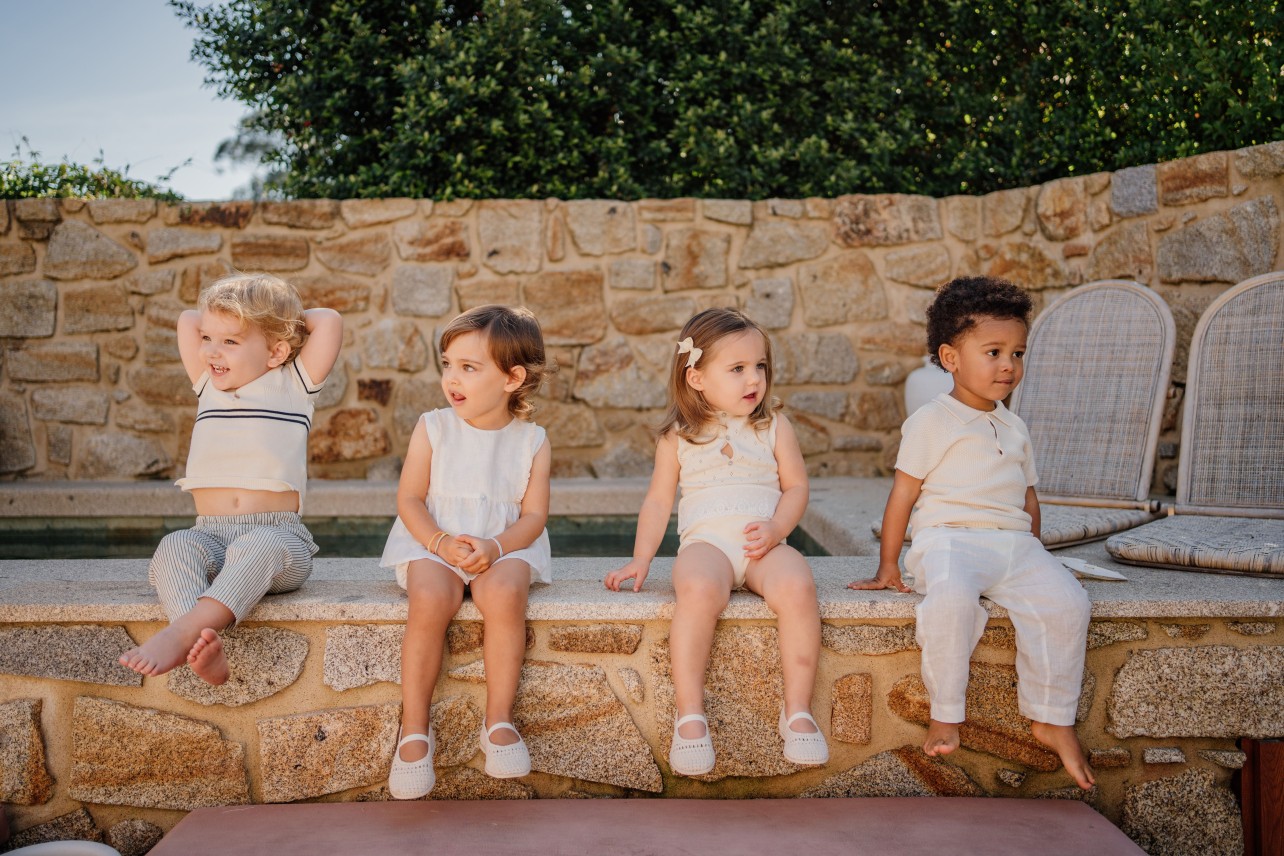
When we talk about friendship, it can have various meanings and interpretations. We believe that friendship, over time, is felt in different ways, whether due to the stage of life we are at or the people we meet and who are close to us. It is a matter of perspective and the meaning that each person gives to their relationships with others.
This definition of friendship already carries with it some experience and life lessons. But what about for little ones? What does friendship mean to children? Here at Wedoble, we witness the relationship between children and we can say that it is the most precious thing.
When creating relationships, there is always that first moment and contact. The first glance. The first touch. Finally, the first interaction, with smiles, some doubts, but with a desire to discover more. The process of getting to know each other is a lot of fun. At this stage, friendship boils down to a relationship between two children who like to play and share the same space, having a good time.
Children bring with them a sense of innocence, which allows us to be uncomplicated when we meet someone new. Of course, this characteristic begins to fade as children grow and develop. However, it is extremely important, and it makes us adults think about how beneficial this factor can be for children when they make their first connections and relationships.
Childhood friends are the people with whom we share every moment of our growing up, and they grow up with us. Trying to think from the perspective of little ones, they will be friends forever and will never, ever part ways. In this aspect, we can already put things into perspective, as there may be changes or simply the friendship ceases to be as clear as ‘I like you, so you're my friend’ to a concept of ‘we've spent so much time together, I identify with you and you're the person I turn to, but I also want to be with you all the time’. Thus, there is a change in meaning, or rather, a deeper and more elaborate meaning. It ceases to be something we have for a reason that is ‘superficial’ for adults and profound for children, becoming something we value according to our experiences and we have a greater awareness of what friendship is and what it can mean to us.

Today we wanted to talk about childhood friendships — the first ones, the first contacts and the first lessons we learn when we get close to someone and that person becomes a permanent part of our lives. For the little ones, these thousand and one thoughts don't even cross their minds, but we believe that, in some way, they will be people who will leave a mark on them and who may remain in this phase of discovery, or progress to a lifelong friendship.
We find this interaction between children fascinating, where the question (or more often a affirmation) ‘Do you want to be my friend?’ is so natural and logical in the whole process of creating a friendship between children that adults watch this behaviour and for a moment feel they are in an uncomplicated, free and completely clear world. Children are experts at making everything simple, and for some reason, it makes us think that if they weren't like that, early friendships wouldn't be so natural. Subsequent friendships become increasingly demanding, based on what we value, what we think, and our circumstances.
In many cases, childhood friends are rare, because it is a friendship that lasts so long and is capable of overcoming various stages of a child's, young person's and adult's life. Otherwise, they can also last through this stage of a child's growth and development and, for some reason, fade away in the experiences and different stages of life that each person finds themselves in.
In this way, we consider childhood friends to be special, as they always convey that sense of simplicity and innocence so characteristic of childhood. These are the friendships that, as they say, last a lifetime. We should enjoy them and keep them close.
What about you? We want to know if you still have close friends from childhood. Are you starting to see your little ones have their first moments of interaction with their new friends? Do you consider childhood friends important for children's development and growth? We want to know about your experience. We want to know your opinion.