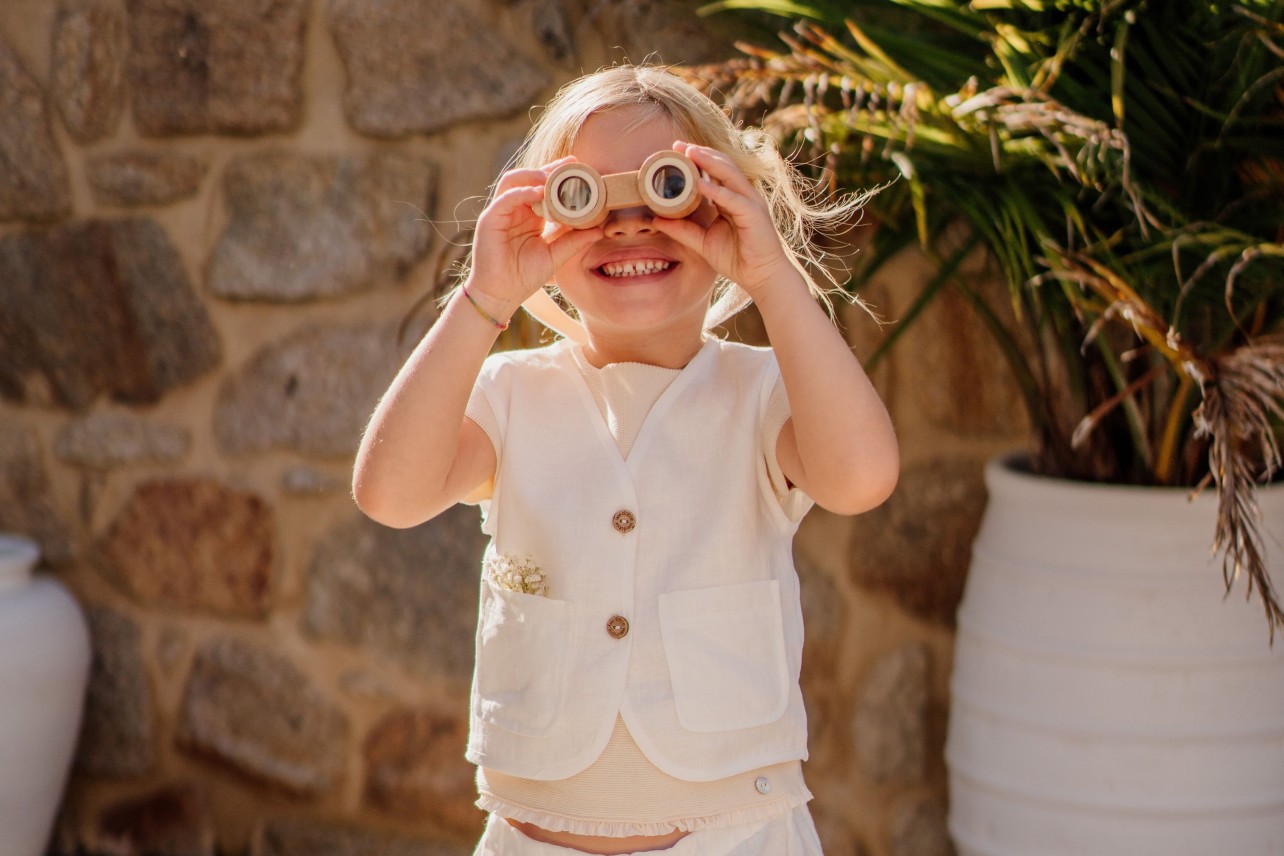
Here we discuss various stages of a baby's growth and development, as well as the various functions that each sense or organ has in the daily life of little ones.
Vision is as important as the other senses, but its development and how it evolves as the baby grows is remarkable. A gradual process is evident, in which their vision becomes increasingly improved.
With this development, how does the little one really see the environment around them? Do they understand it? How can we avoid situations where there is a problem and how can we identify it? Well, these are questions we wanted to understand better, as well as how it develops.
According to our research, we have found that babies can see when they are born, but their vision is very blurred. It is during the first few months of life that their vision becomes increasingly clear, allowing them to perceive and see better.
In this sense, babies are born with small eyes and imperfect vision. After a few months, they begin to distinguish colours and some details that they can make of people, which gives them their own way of understanding their surroundings and the world.
Like all senses, there are several stages in the development of a baby's vision. After birth, a baby can see his or her mother and father, but still has blurred vision and cannot focus on objects that are relatively close — about 30 to 50 cm away. At first, colours all look almost the same, but over time, the baby begins to realise that there are many different colours.
One of the most exciting moments for parents is when their little one can already focus on their faces. Well, we can see how happy they both are!

In detail, we can see that the baby is already showing significant developments in their vision — they can already follow an object with their eyes; they become a true observer of all the faces and objects they encounter; a few weeks later, they can already distinguish green from red. By the fourth month, binocular vision arrives, meaning that distance and depth are now perceptible, and the baby begins to feel the need to pick up objects and understand how they behave.
As the months go by, your baby's field of vision widens, making features increasingly clear and defined. By the end of their first year, their eyes are coordinated with their body movements, which is essential for everyday life and their future discoveries in the world.
We have noticed that, at 18 months of age, babies can further adjust the sharpness of their vision — they can already recognise objects and faces, assess the steps of a staircase, distinguish between different places they visit, and express which ones they like best and which ones they like least.
As children's eyesight develops, it is important to pay attention to certain signs and situations, such as vision problems. It is essential to have regular check-ups with an ophthalmologist, starting in the first year of life. Signs such as red/watery eyes, uncoordinated movement or headaches at the end of the day should be monitored. The earlier the problem is identified, the faster and more effectively it will be treated and the less impact it will have on the child's development. Glasses or visual exercises will be enough to correct the problem.

One problem that we have learned is common in 5% of children is strabismus. This misalignment of the eyes can occur from birth or from the age of 2/3 years. Up to 3 months of age, some lack of coordination is natural. However, in the presence of convergent or divergent movements, it is necessary to have them analysed and evaluated by a professional, who can confirm or rule out certain situations.
A simple test that can be done is to cover one of the baby's eyes and observe their reaction, but it is safer to visit a professional to have the situation analysed.
As we already know, babies' eyes are extremely sensitive to solar radiation. Therefore, on sunny days, especially in summer, it is essential that babies wear hats and sunglasses with a high protection factor and that a sunshade is used on their pram.
Well, we can see that vision, like all the senses, is a very significant factor in a baby's development during the first few months of life. The little one defines their vision well and parents ensure that their little ones have no future problems, but rather perfect vision, always with the help of a professional.
What about you? How was this journey through the eyes of the little ones? What developments did you immediately notice? Any aspects you would like to highlight? We want to know your experience. We want to know your opinion.